AI has its own league table.
Britain's biggest retail bank is only 9th when AI picks a bank. An airline that stopped flying in May is still on it.
In 2 minutes
- Leading your market does not make you AI's first answer: Britain's biggest retail bank is only 9th when AI picks a bank. Track who AI names first on your buyers' questions as a number of its own, next to market share.
- AI decides what your brand is for and when to bring it up. Lloyds calls itself the largest UK digital bank, yet AI brings it up most when someone struggles to open an account. Know what AI says your brand is for, and set it against your strategy.
- AI is slow to learn what changed. It still offers an airline that stopped flying in May, even when it checks the web. Make what AI tells customers a line in every launch, price change and rebrand plan, with one owner answerable for it.
- There is no single position in AI. Among British banks Gemini and Claude clearly prefer Monzo and ChatGPT leans to Starling, and on 45% of questions the favorite changes once AI checks the web. Ask for your position assistant by assistant: one average hides where you win and where you lose.
- Being cited by AI is not being recommended by it. The site two assistants cite most on email marketing belongs to a vendor AI names in 4 of 288 answers. Before you pay for content made for AI, ask for proof that it changed who AI names first.
We asked ChatGPT, Gemini and Claude what to buy in 16 markets, about 16,000 times, with web search on and off. The brand that leads a market is often not the one AI names first. What AI remembers can also be very different from what it finds when it looks.
We wrote our predictions down before each run, and 12 of 32 failed. Before publication, 25 companies named here received what we say about them, with the right to correct a fact.
Who leads the market, and who AI picks first.
On the left, the brands in order of their real size. On the right, in order of how often AI names each one first when people ask what to buy. A line joins each brand, so you see who AI moves up and who it pushes down.
Scroll across to compare both tables.
Britain's biggest retail bank is 9th when AI picks a bank.
By market size
By AI's first picks
Lloyds Banking Group, including Halifax, biggest by customers, ranked by first picks across eight questions. Without web search it is ninth; with web search it shares eighth to eleventh place. Customer numbers from the banks' own latest reports.
Download image (1600 × 900)Britain's biggest retail bank is 9th when AI picks a bank.
By market size
By AI's first picks
Lloyds Banking Group, including Halifax, biggest by customers, ranked by first picks across eight questions. Without web search it is ninth; with web search it shares eighth to eleventh place. Customer numbers from the banks' own latest reports.
Download image (1600 × 900)Britain's 2nd-biggest grocer is AI's first pick on none of 8 questions.
By market size
By AI's first picks
Worldpanel by Numerator, 12 weeks to October 4, 2026.
Download image (1600 × 900)Britain's 2nd-biggest grocer is AI's first pick on none of 8 questions.
By market size
By AI's first picks
Worldpanel by Numerator, 12 weeks to October 4, 2026.
Download image (1600 × 900)Amica has 0.4% of the market and is AI's first pick on claims.
By market size
By AI's first picks
National Association of Insurance Commissioners, 2025.
Download image (1600 × 900)Amica has 0.4% of the market and is AI's first pick on claims.
By market size
By AI's first picks
National Association of Insurance Commissioners, 2025.
Download image (1600 × 900)4 airlines of the same size. AI puts Delta far ahead and still lists one that closed.
By market size
By AI's first picks
US Bureau of Transportation Statistics, August 2025 to July 2026.
Download image (1600 × 900)4 airlines of the same size. AI puts Delta far ahead and still lists one that closed.
By market size
By AI's first picks
US Bureau of Transportation Statistics, August 2025 to July 2026.
* Spirit: 13 first mentions include 3 warnings and 2 other mentions. It is offered first in 8 answers. An AI model read each one.
Download image (1600 × 900)Google sells 3% of US phones and gets at least 14% of AI's first picks.
By market size
By AI's first picks
Counterpoint Research, second quarter of 2026.
Download image (1600 × 900)Google sells 3% of US phones and gets at least 14% of AI's first picks.
By market size
By AI's first picks
Counterpoint Research, second quarter of 2026.
Download image (1600 × 900)The 2 biggest PC makers are AI's first pick in at most 1 answer in 10.
By market size
By AI's first picks
Omdia, second quarter of 2026; includes desktops and business sales, while the AI answers are about laptops.
Download image (1600 × 900)The 2 biggest PC makers are AI's first pick in at most 1 answer in 10.
By market size
By AI's first picks
Omdia, second quarter of 2026; includes desktops and business sales, while the AI answers are about laptops.
Download image (1600 × 900)The 4th-biggest running brand is never AI's first pick.
By market size
By AI's first picks
Circana via SGB Media, 12 months to September 2025.
Download image (1600 × 900)The 4th-biggest running brand is never AI's first pick.
By market size
By AI's first picks
Circana via SGB Media, 12 months to September 2025.
Download image (1600 × 900)In this study
Market leaders are often not AI's first pick.
Leading your market does not make you AI's first answer.
of AI's first picks in British banking go to Lloyds, the biggest retail bank. Monzo, little more than half its size, gets 27%.
What it means
The people who ask AI can hear a different order from the one in your sales figures. A leader cannot assume AI repeats its lead, and a smaller rival can be the first name a customer hears.
What to do
Make AI's first pick on your buyers' main questions a number your board sees, next to market share.
From memory
With web search
See the evidence
Lloyds Banking Group serves more UK customers than any other bank group, about 28 million. Across eight everyday banking questions, ChatGPT, Gemini and Claude put it first in 3% of their answers without web search and 2% with it. Monzo, with little more than half as many customers, gets 27% both ways, whichever question we leave out. Even on the plainest question, the best bank account in Britain, AI names Lloyds first in none of 90 answers without web search and none of 36 with it.
People are already asking. In research for the FCA in April 2026, 16% of British bank customers said they use AI to support their personal finances.
We ran the same test in six markets with public size figures, with the rule written down beforehand. In three of them, AI's most frequent first pick is not the market's leader, with web search on or off.
| Market | The market's leader | AI's first pick, without web search | With web search |
|---|---|---|---|
| British banking | Lloyds Banking Group | Monzo, 27% (Lloyds 3%) | Monzo, 27% (Lloyds 2%) |
| British supermarkets | Tesco | Aldi, 30% (Tesco 21%) | Aldi, 29% (Tesco 23%) |
| US car insurance | State Farm and Progressive | USAA, 26% (17% and 15%) | USAA, 19% (16% and 6%) |
| US airlines | Delta, American, United, Southwest | Delta, 38% | Delta, 29% |
| US running shoes | Brooks and Hoka | Brooks, 42% | Brooks, 21% |
| US smartphones | Apple | Apple, 31% | Samsung, 30% (Apple 27%) |
Two of those three rest on one question, and we would rather say so than have you find out. USAA leads only because we asked a question from military families. Without it, State Farm leads. Aldi leads thanks to the question on the cheapest shop, where AI usually names Lidl in the next breath. Without it, Tesco leads, or M&S when AI searches. Monzo needs no such help.
Inside the markets the gaps get wider:
- Google sells 3% of America's phones and gets at least 14% of AI's first picks.
- HP and Dell sell almost half of America's PCs. AI names them first in 5% of answers, 10% when it searches.
- Amica writes 0.4% of America's car insurance. Ask who to trust with a claim and AI says Amica.
- On is America's fourth-biggest running shoe brand. It comes first in none of 720 answers without web search and none of 288 with it.
AI knows most of the big names. It mentions Sainsbury's in about two answers of three, yet starts with it in 7% of answers without web search and 1% with it. In insurance, groceries and airlines, the bigger the brand, the more often AI names it, and who comes first follows size much less closely. Size gets you on the list. It does not put you at the top.
AI decides what your brand is for.
AI decides what your brand is for and when to bring it up, and its view can lag behind your strategy.
of AI's answers that name Lloyds mention apps, against 53% for Monzo. Lloyds calls itself the largest UK digital bank.
What it means
When AI's view lags behind your strategy, the customers who ask it meet the company you used to be.
What to do
Make one person answerable for what AI says your brand is for, and set it against your strategy every quarter.
From memory
With web search
Some of the apps named with Lloyds are other companies'.
Every answer that names the bank: Monzo 426 without web search and 184 with it, Lloyds 215 and 80.
See the evidence
We had an AI model sort what the assistants say about 44 brands in seven markets. For 11 of them, one reason runs through at least half of what AI says, with web search and without. For seven of the 11, price does. Aldi's word is price, in more than eight answers of ten. Marks & Spencer's is quality, Hoka's is cushioning, and AI talks price about most big car insurers. About Amica, which writes 0.4% of the market, it talks service and claims, in about three answers of four.
- AldiPriceWithout web search: 87%With web search: 83%
- Marks & SpencerQualityWithout web search: 67%With web search: 53%
- HokaCushioningWithout web search: 73%With web search: 63%
- AmicaService or claimsWithout web search: 80%With web search: 70%
- SouthwestBags and feesWithout web search: 60%With web search: 50%
- MonzoIts app or money toolsWithout web search: 67%With web search: 60%
- LloydsBranches or traditionWithout web search: 53%With web search: 23%
Each cell is 30 answers that name the brand.
Download image (1600 × 900)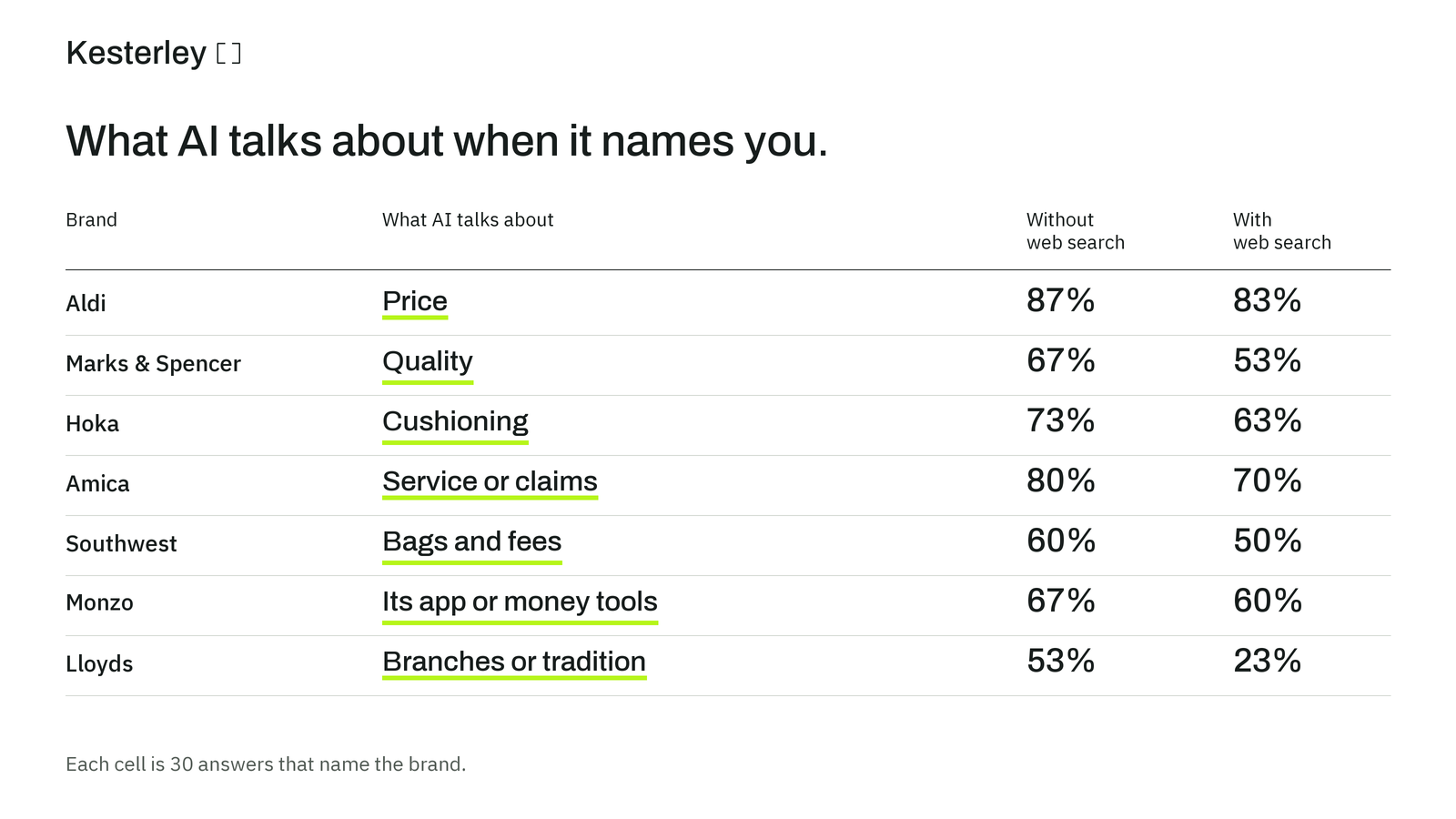
A company can move faster than its word. Lloyds Banking Group calls itself the largest UK digital bank, with around 22 million mobile app users. Monzo now counts more than 16 million customers in all. Yet apps come up in 53% of the answers that name Monzo and 22% of those that name Lloyds, 57% and 23% with web search, and some of Lloyds's are other companies' apps. AI also decides when you come up. It brings Monzo up when someone wants to budget, in 85 of 90 answers. It brings Lloyds up most when someone struggles to open an account, with a poor credit history or no UK credit file, in 60 of 90.
The word can also be out of date. Southwest ended free checked bags for most customers in May 2025. Without web search, 153 of the 465 answers that name it still offer them as a plain fact. Gemini: "Every passenger gets two free checked bags." With web search on, 28 of 179 still do, and 10 say the policy ended. ChatGPT gets it right each time. On the one question we re-ran on the newer Claude, 9 of the 14 answers that mention Southwest's checked bags say they now cost money.
We also predicted that brands with one clear word would come first more often. That did not hold: the word does not put you first. None of this shows in a sales report or a brand tracker, and we cannot see what it does to sales. But AI has written a one-line brief for your brand.
AI still recommends brands that are gone.
AI still recommends names that are gone from the market, even when it searches the web.
answers about cheap US flights with web search still offer Spirit, six months after it stopped flying.
What it means
What you change in the real world can take months or years to reach AI's answers. A withdrawn product, an old name, a closed deal or an ended policy can live on in front of your customers.
What to do
Make what AI tells customers a line in every launch, price change and rebrand plan, with one owner answerable for it.
| With web search | Names Spirit | Warns that it closed | Offers it as an option |
|---|---|---|---|
| 11 | 9 | 1 | |
| 14 | 1 | 5 | |
| 24 | 7 | 7 |
See the evidence
Spirit Airlines stopped flying on May 2, 2026. Give the assistants web search, and 49 of 287 answers about US airlines still name it. 17 warn that it has closed. 13 offer it as an option, without a word about the closure. The other 19 treat it as flying, in tables of fees, rankings or cautions about bag charges. On cheap flights, one answer in three still offers it, and 10 of those 12 list their sources. Without web search, 211 of 720 answers name it, and not one says it has closed.
| With web search | Names Spirit | Warns that it closed | Offers it as an option |
|---|---|---|---|
| ChatGPT | 11 | 9 | 1 |
| Gemini | 14 | 1 | 5 |
| Claude | 24 | 7 | 7 |
Spirit is the extreme case, not the only one. Strike bought Purplebricks for £1 in 2023, and strike.co.uk now takes you to Purplebricks. Without web search AI still names Strike in 38% of answers about estate agents, and in 15% with it. OnePlus stopped launching new phones in North America in July, and AI still names it in 16% of answers without web search and 7% with it.
AI changes its answer when it checks the web.
You have two positions in AI, one in what it remembers and one in what it finds when it searches.
of questions get a different favorite once AI searches the web. Even without search, two batches of answers to the same questions name a different favorite on 21%.
What it means
What AI remembers changes only with a new model and can be years old. What it finds can change as fast as the web, so a brand can look safe in one and exposed in the other.
What to do
Track your position in AI as two numbers, from memory and with web search, and recheck both whenever a new model comes out.
From memory
With web search
See the evidence
Give an assistant web search and its favorite changes on 45% of questions. Before the run we wrote down that at least five favorites in eight would hold. They did not. Chance explains part of the change: split the answers without web search in two and the favorite changes on 21% of questions. The rest is the search.
Falls
Brooks42% to 21%Running shoes (US)
Emma28% to 12%Mattresses (UK)
Purplebricks27% to 6%Estate agents (UK)
HubSpot66% to 51%CRM software
Progressive15% to 6%Car insurance (US)
Waitrose16% to 8%Supermarkets (UK)
Rises
Marks & Spencer13% to 23%Supermarkets (UK)
Amica8% to 15%Car insurance (US)
Yopa4% to 12%Estate agents (UK)
Harringtons4% to 11%Dog food (UK)
American Airlines<1% to 7%Airlines (US)
Samsung23% to 30%Smartphones (US)
Holds
Monzo27% to 27%Banking and money apps (UK)
Deel35% to 36%HR and payroll
Apple38% to 40%Laptops (US)
Oura29% to 31%Smart rings and fitness watches (US)
Simba21% to 22%Mattresses (UK)
Aldi30% to 29%Supermarkets (UK)
Claude names Mailchimp for a small firm's first email tool in 30 answers of 30. In the 8 answers where it searched, it names MailerLite in 7. Gemini names Remote for hiring abroad from memory and Deel when it searches. Emma is AI's favorite mattress until it searches.
The sites AI reads most are not the brands it recommends.
Being cited by AI is not the same as being recommended by it.
answers name Sequenzy, the email marketing vendor whose site two of the assistants cite most.
What it means
Much of the advice on winning in AI is about getting cited. In our data being cited and being recommended can come apart completely, so a rising count of citations does not show that AI recommends you more.
What to do
Before you pay for content made for AI, ask the seller to show that it changed who AI names first, not how often a site is cited.
See the evidence
With web search on, a handful of sources sit behind the answers. Which? appears in 44% of the answers on British supermarkets that list sources. RunRepeat appears in 39% on running shoes and NerdWallet in 32% on US car insurance. In business software AI reads the vendors: Deel's own site appears in 31% of the answers on HR and payroll, HubSpot's in 30% on CRM.
The site Gemini and Claude cite most in email marketing belongs to Sequenzy, a vendor founded in 2025. It has done what the guides to AI visibility advise: a file written for AI crawlers, a table of facts "for buyers, journalists, and AI assistants", buttons that open ChatGPT, Claude and Gemini with a question ready. Gemini and Claude cite it in 93 of the 178 answers where they list sources. ChatGPT cites it in none of 95. AI names Sequenzy in 4 of 288 answers. In the answers that cite it, AI names Mailchimp, MailerLite and Klaviyo first, about as often as anywhere else.
The citations may still bring Sequenzy visitors; we cannot see that. We have not measured what happens when a page changes, and we will not sell you a tactic we have not tested.
Each AI assistant ranks your market differently.
The three assistants do not share one league table, so the one your customers use can change the brand they hear first.
questions on electric cars, at most, where ChatGPT, Gemini and Claude agree on the favorite.
What it means
There is no single AI market. An average across the three assistants can hide a rival who leads in the one your customers use.
What to do
Find out which assistant your customers use, and judge your position there first.
From memory
| Market | By AI's first picks | All three agree |
|---|---|---|
| Tesla 22% | 1 of 8 | |
| Monzo 27% | 3 of 8 | |
| HubSpot 66% | 7 of 8 |
With web search
| Market | By AI's first picks | All three agree |
|---|---|---|
| Tesla 16% | 0 of 8 | |
| Monzo 27% | 2 of 8 | |
| HubSpot 51% | 5 of 8 |
See the evidence
Among British banks ChatGPT leans to Starling, with web search or without. Gemini and Claude clearly prefer Monzo. On electric cars the three share a favorite on at most one question of eight. Some choices are settled: run Microsoft 365 and even ChatGPT tells you to buy Copilot, in every answer. And sometimes AI names no one: ask ChatGPT who should sell your house, and more than half the time it names no firm.
They also answer differently. In the sample of 320 answers an AI model classified one by one, ChatGPT gives a clear pick in about six answers of ten, Gemini in about four and Claude in three. With Claude, being first more often means being first on a list.
| Market | First, without web search | All three agree | First, with web search | All three agree |
|---|---|---|---|---|
| CRM software | HubSpot, 66% | 7 of 8 | HubSpot, 51% | 5 of 8 |
| AI assistants for business | ChatGPT, 47% | 4 of 8 | ChatGPT, 37% | 3 of 8 |
| HR and payroll | Deel, 35% | 3 of 8 | Deel, 36% | 5 of 8 |
| Email marketing | MailerLite, 20% | 4 of 8 | MailerLite, 19% | 3 of 8 |
| Car insurance (US) | USAA, 26% | 3 of 8 | USAA, 19% | 3 of 8 |
| Airlines (US) | Delta Air Lines, 38% | 3 of 8 | Delta Air Lines, 29% | 3 of 8 |
| Smartphones (US) | Apple, 31% | 5 of 8 | Samsung, 30% | 5 of 8 |
| Laptops (US) | Apple, 38% | 6 of 8 | Apple, 40% | 5 of 8 |
| Running shoes (US) | Brooks, 42% | 2 of 8 | Brooks, 21% | 3 of 8 |
| Smart rings and fitness watches (US) | Oura, 29% | 6 of 8 | Oura, 31% | 6 of 8 |
| Banking and money apps (UK) | Monzo, 27% | 3 of 8 | Monzo, 27% | 2 of 8 |
| Supermarkets (UK) | Aldi, 30% | 6 of 8 | Aldi, 29% | 5 of 8 |
| Electric cars (UK) | Tesla, 22% | 1 of 8 | Tesla, 16% | 0 of 8 |
| Mattresses (UK) | Emma, 28% | 0 of 8 | Simba, 22% | 3 of 8 |
| Dog food (UK) | Royal Canin, 18% | 1 of 8 | Royal Canin, 12% | 2 of 8 |
| Estate agents (UK) | Purplebricks, 27% | 0 of 8 | Rightmove, 17% | 2 of 8 |
What it means for your company.
Your position in your market and your position in AI's answers are two different facts. Your sales figures and your brand research show the first. Neither shows the second.
We expect AI to stand between most companies and most of their customers within a few years. That makes the second position a question for the board, not only for marketing. For a leader it is a position to keep, and every new model can move it. For a challenger it is an opening the leader's size does not shut: Amica writes 0.4% of America's car insurance, and when people ask who to trust with a claim, AI says Amica.
Measure it the way you measure market share: on the questions your buyers actually ask, assistant by assistant, from memory and with web search, and again after every new model.
See where your company stands.
A Position Map tells you where you stand on the questions your customers ask before they buy, why AI puts a rival first, which findings are firm and what to do first, and you get an hour with the person who wrote it. From $2,500. Two weeks.
Talk to usHow we measured.
- Sixteen markets. Business software: CRM, AI assistants for business, HR and payroll, email marketing. Consumer markets in the US: car insurance, airlines, smartphones, laptops, running shoes, smart rings and fitness watches. Consumer markets in Britain: banking and money apps, supermarkets, electric cars, mattresses, dog food, estate agents.
- Eight buying questions per market, each in six wordings, put through the official developer access to GPT-6 Luna, Gemini 3.5 Flash-Lite and Claude Sonnet 5. Without web search, five times each: 720 answers per market. With web search switched on, twice each: 288 per market. We never add the two modes together. Each assistant gets the same questions the same number of times.
- The free apps change models often. Gemini's free app routes each question for itself, and Claude's free app moved to Sonnet 5.5 at the end of September, so Claude's figures describe the model before it. We re-ran two questions on Sonnet 5.5, 84 answers. Asked for the best bank account, it names Lloyds first once in 30 answers and never in 12 with web search, though without web search it starts with First Direct and Starling more often than Monzo. Asked for the cheapest airline without web search, it names Spirit first in 9 of 30 and never says it closed, though 15 of the 29 answers naming it warn about its finances. With web search, 8 of 12 say it shut down. We measure the rest on that model in the next edition.
- In all 16,028 answers, 25 to 30 October 2026. Another 100 came back empty. Without web search the 92 empty ones count as naming no one, so each share there is of all 720 answers asked in a market. With web search the 8 empty ones are left out.
- We count the first brand each answer names. To test that, a separate AI model classified a random sample of 320 answers one by one, ten per market and mode. In 90% the first brand named is offered as a choice: in 44% as the clear pick, in 46% as the first of several. In 7% it is only an example and in 2% a warning, and 1% were miscounts. Coming first often means first on a list, which is why we say "named first".
- What AI says when it names a brand: 30 answers per brand and mode, picked at random, 2,604 in all. An AI model labeled the reasons on lists fixed beforehand, up to two per answer. A second model labeled 300 of them on its own and shared at least one reason in 95% of them. We checked the sharpest lines with plain keywords on every answer naming the brand, and the app figures for Monzo and Lloyds come from that count. Of 24 predictions about single brands fixed beforehand, 16 held. Those that failed include what AI says about Delta, about Apple and about Motorola. An AI model also read, one by one and to written rules, all 211 passages on Southwest's free bags and all 49 answers with web search that name Spirit.
- With web search on, each assistant decides for itself whether to look. ChatGPT and Gemini listed sources in 94 to 100% of their answers in each market, Claude in 83 to 100%.
- Questions, wordings, brands and predictions were fixed and fingerprinted before each run. Of the 32 predictions behind this page, 12 failed. Three of the seven about web search: that at least five favorites in eight would hold when AI searches, that Hoka would get under half of Brooks's first picks with search, and that the three assistants would share a favorite on at most two mattress questions with search. Eight of the 24 about what AI says when it names a brand, and the one that brands with one clear word come first more often.
- Size figures: the banks' own latest reports (UK banking); Worldpanel by Numerator (UK supermarkets); National Association of Insurance Commissioners (US car insurance); US Bureau of Transportation Statistics (US airlines); Counterpoint Research (US smartphones); Omdia (US PCs, including desktops, so that comparison only describes); Circana via SGB Media (US running shoes). Sale of Purplebricks: Mortgage Solutions and City AM, May 2023; strike.co.uk redirecting to purplebricks.co.uk, checked November 3, 2026. Spirit's closure: its SEC filing of May 2026. OnePlus: company statement, July 16, 2026. Sequenzy: its own site. App users: Lloyds Banking Group half-year results, July 30, 2026. Monzo's customers: monzo.com/about, November 2026. Southwest's bags: its press release of March 11, 2025 and its help pages. Use of AI for money: FCA Mills Review, consumer research by Yonder, April 2026; Lloyds Banking Group Consumer Digital Index 2025.
- Before publication, 25 companies named in the text received what we say about them, with the right to correct a fact.
How to read it.
These are AI answers, not market shares. They show what AI tells people who ask, not what people buy. The apps can also search the web on their own and remember the user, so your answer may differ. In our CRM check, the paid ChatGPT app, which runs a newer model than the one we measure, put the same brand first as our measurement on 9 of 10 questions, and on 3 of the 4 where our favorite was not HubSpot. The Gemini app did so on 6 of 10. It said it had searched the web, and against our measurement with web search it agreed on 7 of 8, including all 4 where our favorite was not HubSpot. On November 3 we put four of these questions to the ChatGPT, Gemini and Claude apps ourselves, one answer each. Two of the three still listed Spirit among the low-fare airlines. One added that it had stopped flying. The other offered it for a weekend trip at $35 to $89 one way, with no warning at all, and told us in 3 of 4 answers that Southwest still gives two free checked bags. None of the three put Lloyds among the accounts it recommended.